
PSYPACT Explained: An Overview of the Psychology Interjurisdictional Compact
About Course
AK-PA members please use coupon code AKPA-Member to receive a 40% discount off published pricing.
This course was presented live on October 19, 2026 and is available as a webinar through October 19, 2028. If you attended the live presentation use coupon code PrePay25 to view it up to 3 times at no cost.
Alaska, Iowa, Nebraska, Michigan and Louisiana passed PSYPACT Legislation this year and are the newest to join the Psychology Interjurisdictional Compact (PSYPACT) which became operational in 2019. Alaska’s official start with PSYPACT is Sept 20, 2026.
CE Units: 3.0
Program Description
In an era of rapidly evolving technology, telepsychology has become an indispensable tool for expanding access to behavioral health services. However, this transformative modality brings with it a complex web of legal, ethical, and regulatory considerations that demand careful attention. This presentation will provide an in-depth overview of the Psychology Interjurisdictional Compact (PSYPACT) and its implications for psychological practice in your state.
Attendees will gain a comprehensive understanding of PSYPACT’s structure, its benefits for practitioners and clients, and the regulatory considerations for cross-state telepsychology and temporary in-person practice. The session will highlight recent developments, practical steps for psychologists to participate in PSYPACT, and strategies to maximize the opportunities PSYPACT offers. Ample time will be allotted for discussion of common challenges, ethical considerations, and attendee questions.
Program Learning Objectives:
At the conclusion of this program, attendees will be able to:
- Attendees will be able to discuss the implications of cross-jurisdictional practice, including what an interstate compact is (and one example of a compact).
- Attendees will be able to describe PSYPACT and two things that it allows psychologists to do to ethically and legally practice according to regulations, and what the governing documents for PSYPACT are, and where to locate them.
- Attendees will be able to explain the potential consequences of non-compliance with legal and ethical standards in telepsychology, including disciplinary actions, risk of enforcement, and other penalties (e.g., audits, investigations).
Who should attend: Licensed Clinical Psychologists.
Please note that LPAs and LPCs can attend but they are not eligible to join PSYPACT. Additionally, a Social Worker Compact passed this year, and Social Workers should contact NASW Alaska for more information.
About the presenter:
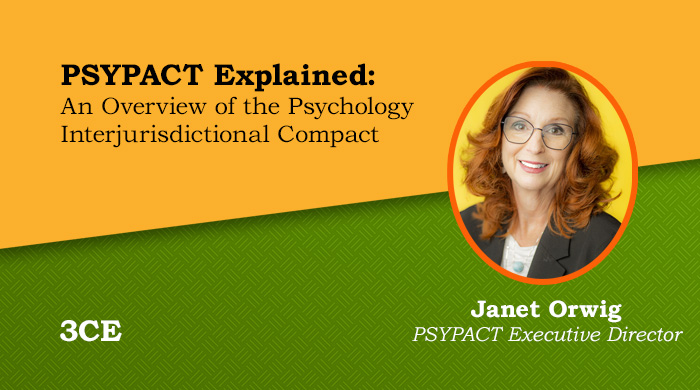
Janet Orwig, MBA, CAE, has led the Psychology Interjurisdictional Compact (PSYPACT) as its executive director since 2015. In her position with the Association of State and Provincial Psychology Boards (ASPPB), she supports the Compact’s governing body, the PSYPACT Commission. Janet manages the day-to-day operations of PSYPACT, including implementing compact and regulatory compliance. She plays an integral part in developing new services and programs, securing and managing large government grants, and furthering stakeholder relations. Her 28-year career in association management includes experience in customer service, communications, public relations, advocacy, strategic planning and implementation, leadership development, and project and program management. Janet earned her Paralegal Certificate and bachelor’s in business administration from Huntingdon College and her MBA from the University of Phoenix. She is a Certified Association Executive.
Alaska Psychological Association (AK-PA) is approved by the American Psychological Association to sponsor continuing education for psychologists.
AK-PA maintains responsibility for this program and its content.
Course Content
Powerpoint
-
PSYPACT Explained: An overview of the Psychology Jurisdictional Compact
Video
Test for CE Credit
Student Ratings & Reviews
